Post-Industrial Determinism: The Evolution of Computing Systems, Code Inflation, and the New Data Economy
The modern software industry stands on the threshold of a phase transition: code becomes intermediate raw material, and the surface layer of the web devalues to the price of a token. What stays valuable in that economy — and who keeps it.
Introduction: The crisis of marginal development cost
The modern software industry stands on the threshold of a phase transition. The technology stack is shifting from hand-written code to automated generation and optimisation via deep-learning artifacts. To understand binary executables (binary artifacts) and complex codebases ($codebase$) not as finished software products but as intermediate raw material radically changes the economic model of SaaS and web applications.
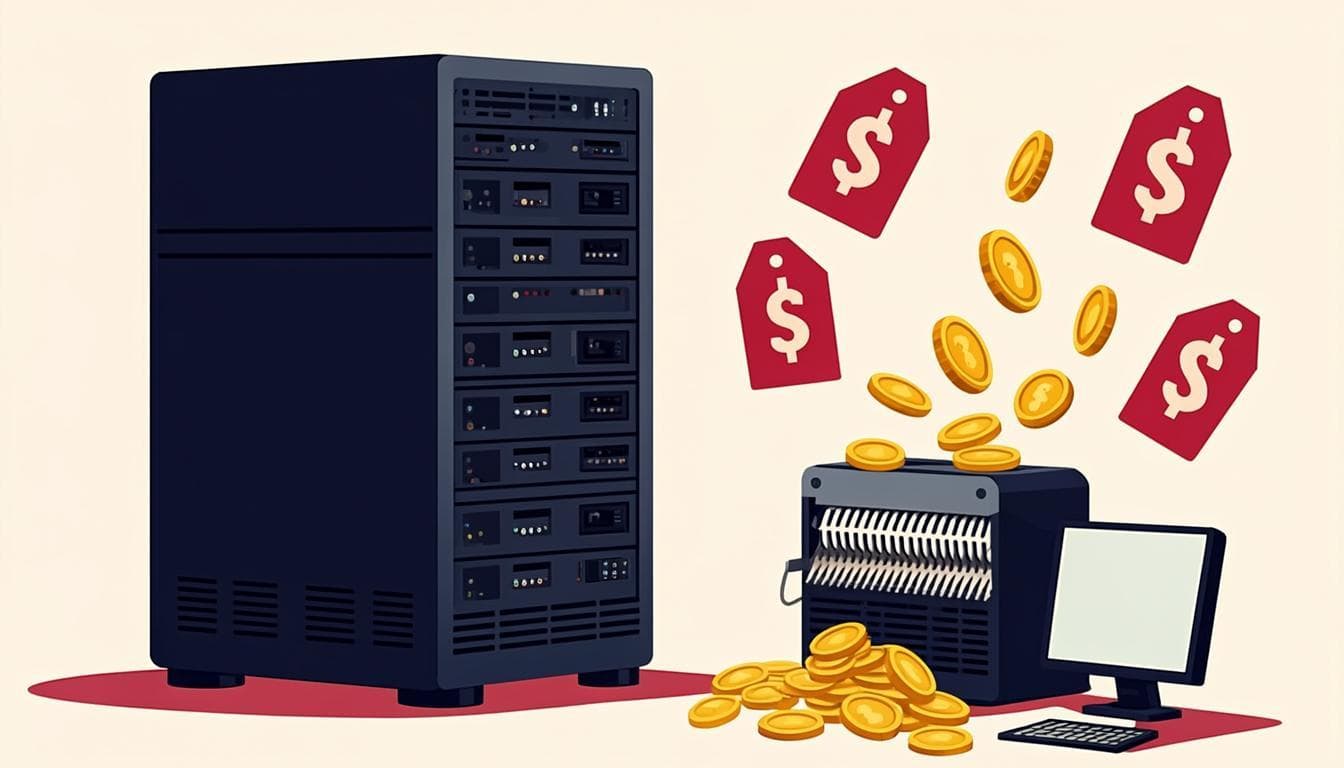
If bulky compiled systems can be decomposed and mass-rebuilt automatically, then the surface layer of Web/SaaS applications is devalued down to the price of a token.
1. The architectural dichotomy of computing: Edge vs. data centers
Neural architectures are developing along a path of bidirectional differentiation:
[AI infrastructure evolution]
       │
       ├──► Local level (Edge / CPU-only)
       │    └─ Efficient quantisation and distillation
       │    └─ DeepSeek V3/R1-class models on home hardware
       │
       └──► Centralised level (Hyperscalers)
            └─ Frontier models (Opus 5.5, GPT Astra)
            └─ Instant synthesis of complex ecosystems (games / SaaS)
Local systems (Edge Compute)
Thanks to knowledge-distillation algorithms, advanced quantisation methods (4-bit/2-bit) and hardware optimisation, local neural networks are making a technological leap.
In the near future, models comparable in capability to today's DeepSeek family will run on standard consumer hardware (general-purpose CPUs without discrete accelerators). This will create an autonomous, high-performance local layer of development, working directly on client machines.
Data centers and multi-agent generation
At the opposite pole are data-center clusters. Frontier models of the next generation (conditional names: Opus 5.5, GPT Astra) are moving from generating individual functions to the parallel synthesis of functional platforms:
- Web services and applications: synthesis of the full stack (front/back/db) in minutes.
- Game engines and ecosystems: several variations of complete interactive software generated from a single prompt within a couple of hours.
The economics of inference costs
The current cost of running requests (inference) on frontier models — $50–$100 per 1M tokens — makes direct app generation economically unviable for the mass consumer, for whom paying for a standard $30/month subscription is cheaper.
Yet the law of accelerating returns devalues today's flagship models to baseline level within 12–18 months. The technologies that form the frontier today will end up on the "technology scrapheap" tomorrow, turning into an accessible public resource.
Practical takeaway for a developer: your tooling and personal software must be designed today around resilient, locally-oriented harnesses (of the DeepSeek Harness class) — building infrastructure "for yourself", not for temporary proprietary APIs.
2. The erosion of traditional economic sectors
Filtering technological noise out of the real mainstream leaves only three stable sectors of value generation in the transition period:
- Trade (distributive commerce)
- Craft and physical labour (Handwerk / skilled labor)
- Closed / proprietary data (non-simulable private data)
+-----------------------------------------------------------------+
|                       CURRENT STATUS QUO                        |
|   [Trade]            [Physical Craft]       [Private Data]      |
+-----------------------------------------------------------------+
                                │
                                ▼  (Cheap robotics arrives)
+-----------------------------------------------------------------+
|                   POST-INDUSTRIAL SHIFT                         |
|   [Corporations/Agents]     [AUTOMATED]     [The only           |
|                                              capital]           |
+-----------------------------------------------------------------+
Geopolitical context and the sovereignisation of production
The current geopolitical conflict between the US and China is tied to attempts at reindustrialisation and at preserving the Handwerk segment (the production base). Countries are trying to keep physical production within national borders to prevent catastrophic structural unemployment.
The robotic shift
As soon as the cost of owning and operating robots falls below the cost of human labour at superior quality:
- The craft sector (Handwerk) collapses entirely.
- The trade sector finally passes under the control of transnational corporations and is fully delegated to autonomous trading agents.
At that point, classical capital and labour lose their defining role.
3. The era of "data as the new gold"
When algorithms and physical labour become endlessly reproducible commodities with zero marginal cost, the only valuable resource left is data that is not publicly available and cannot be statistically simulated.
If data can be modelled on the basis of existing open datasets, it holds no value. Real worth belongs only to unique physical, behavioural, narrow-specialist or historical datasets.
Threats and defensive infrastructure
Data sovereignty becomes the central security task:
- Devaluation through leaks: leaks and mass data plunder will periodically devalue exclusive datasets by dumping them into the public domain.
- Active data defence: owning data will require not just passive storage but active counter-intelligence measures: planting false patterns, systematically disinforming collection algorithms, harvesting other people's data and managed forgery.
4. The socio-legal scenario: piracy, passive conformism and total surveillance
In the event of radical social transformations, states and corporations will attempt to outlaw private autonomous models, driving all computing power inside the perimeter of corporate data centers.
+-----------------------------------------------------------------+
|                  EVOLUTION OF THE CONTROL SYSTEM                |
|                                                                 |
| [Current phase: P2P / Torrent] ──► [Mega-Datacenter Phase]      |
| (Local workarounds)               (Continuous telemetry         |
|                                    and total control)           |
+-----------------------------------------------------------------+
In the transition period, a dynamic similar to the historical phenomenon of P2P networks (torrents) will emerge:
- Temporary "pirate" immunity: just as Photoshop-class software once became universally available despite licences, so local AI models will spread through grey channels with their restrictions cracked.
- The hardware-limit principle: until now, total control over every individual has been technically impossible — there was simply not enough computing power to process the personal context of billions of people.
But this window of P2P freedom is strictly temporary. Once the scale of data centers reaches the level at which the behaviour of every individual on the planet can be aggregated, filtered and analysed in real time, the pirate scenario will be eliminated. Total control will become not so much an ethical decision as an engineering function of the infrastructure.
5. The financial dead end of global capital
The only thing holding back the arrival of this era right now is the strategic confusion of global capital. The investors who control states and world financial flows have frozen before a hardware fork.
Building infrastructure at the required scale on the current architecture (NVIDIA GPUs) requires trillion-dollar spending. But committing that money is mortally dangerous:
- Alternative paradigms are on the way — from neuromorphic processors to photonics and specialised ASICs.
- Any technological breakthrough in fundamental hardware would instantly turn today's supercomputer clusters into billions of dollars of scrap metal.
Global capital has taken a pause. It is waiting for the moment when the final standard of the future's hardware platform emerges.
Conclusion: an existential choice and the unpredictability of the new order
When investment capital settles on the base hardware and paves the planet with next-generation data centers, the old social order will collapse. A scenario of mass destruction or hard displacement of the population is nevertheless unlikely: corporate monopolies do not need decimation — they need stability, controllability and a predictable environment.
Under these conditions, society faces two fundamental paths of survival and adaptation:
1. The conformist strategy (the majority strategy)
For the overwhelming mass of people, the natural reaction will be passive submission. As history shows, the majority chooses to embed itself in the existing social contract, surrendering the remains of its autonomy in exchange for predictable basic goods (a conditional UBI, subscription access to ecosystems and managed comfort). Humanity does not have to fight for its own infrastructure in order to survive — it is enough to follow the rules set by corporations and the state.
2. The infrastructure-autonomy strategy (techno-dissidence)
For a narrow layer of critically thinking individuals, the only way to preserve real independence and agency remains building one's own local technological base. While capital is confused, while autonomous hardware and DeepSeek-class models are available, the window for building a personal toolkit — one that depends on no external servers and no corporate subscription terms — stays open.
The unpredictability of the post-crisis world
The main factor of uncertainty is that any social upheaval and civil conflict recalculates the balance of power from zero. The new order that emerges after global crises cannot be modelled in advance. In what form corporations and the remaining state institutions will interact with the population — whether there will be room for the grey market, for local models and for personal autonomy, or whether conformism becomes the only ticket to the future — only the moment when the global data-center clusters come online at full power will show.
Share this note
Responses
RESPONSES (0)
Every response is read by a human before it appears here. Keep it honest, keep it civil.
No responses yet — the first one is yours.